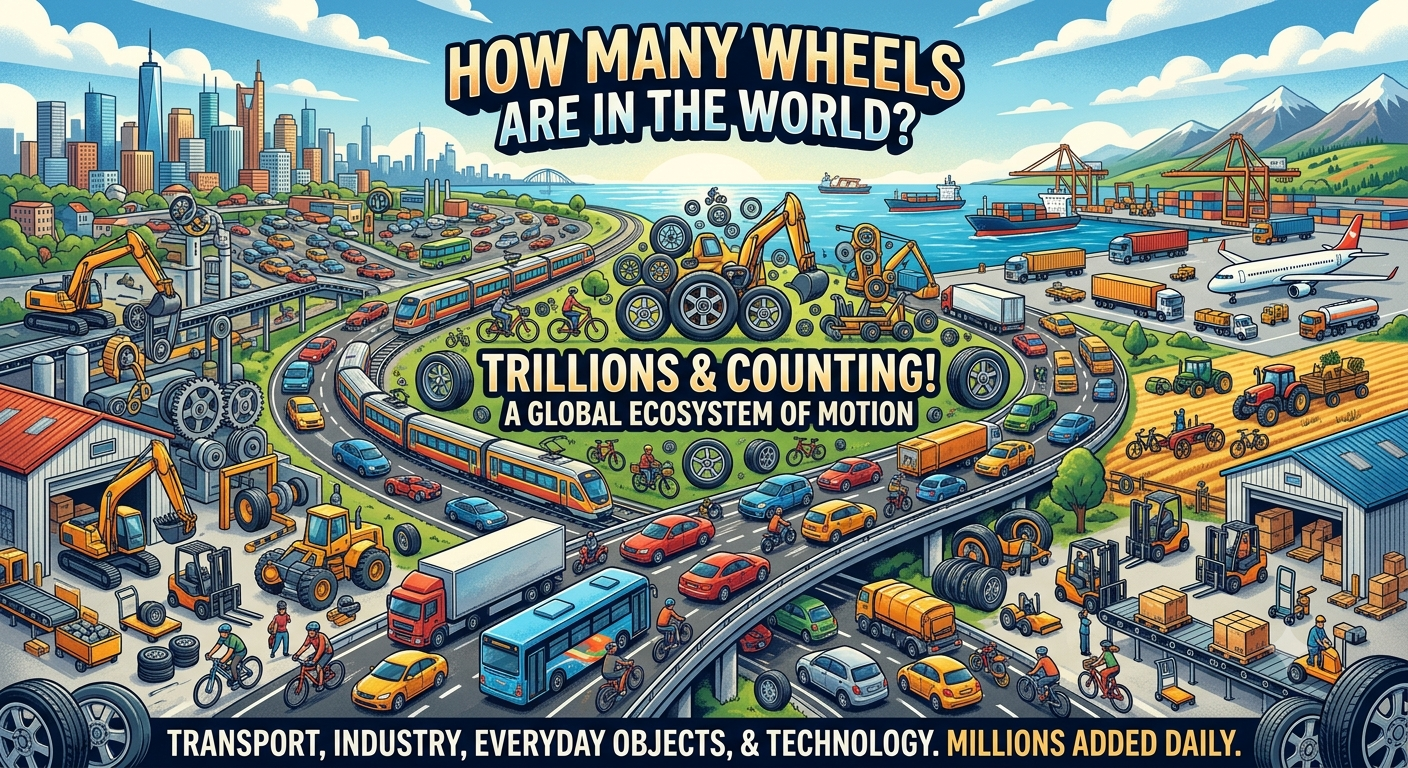
The question “How many wheels are in the world?” became popular through internet debates, quizzes, and the famous “wheels vs. doors” discussion. While it sounds simple, calculating the exact number is impossible because billions of new wheels are manufactured every year, while old ones are discarded or recycled.
Although there is no official global count, experts generally agree that the total number of wheels is well into the tens of billions, with many modern estimates ranging from 20 billion to more than 90 billion, depending on what types of wheels are included.
This guide explains where those wheels come from and why the total is so enormous.
Is There an Exact Number?
No.
There is no worldwide database that records every wheel in existence.
The total changes constantly because:
- New vehicles are manufactured every day.
- Toys are produced in huge numbers.
- Office furniture is replaced.
- Industrial equipment is installed.
- Old products are recycled or discarded.
For these reasons, every published figure is an estimate rather than an exact count.
Estimated Number of Wheels Worldwide
Most reasonable estimates fall into this range:
| Estimate | Includes |
|---|---|
| 20–35 billion | Vehicles, bicycles, furniture, industrial equipment, and common household items |
| 37–93 billion | Adds large numbers of toy wheels, factory rollers, luggage, carts, and other small wheels |
Because definitions vary, different researchers reach different totals.
Where Do All These Wheels Come From?
Many people immediately think of cars, but vehicles account for only part of the total.
Cars and Light Trucks
There are roughly 1.5 billion passenger vehicles worldwide.
With four wheels each—and often a spare—that alone contributes more than 6 billion wheels.
Bicycles
There are an estimated 1 billion bicycles around the world.
Since each bicycle has two wheels, that’s roughly 2 billion bicycle wheels.
Motorcycles and Scooters
Millions of motorcycles, scooters, and mopeds add billions more wheels globally.
Commercial Vehicles
Additional wheels come from:
- Trucks
- Buses
- Trailers
- Construction equipment
- Agricultural machinery
Heavy-duty vehicles often have far more than four wheels.
Toy Wheels Add Up Quickly
One of the biggest surprises is that toy wheels may outnumber vehicle wheels.
Examples include:
- Toy cars
- Toy trucks
- LEGO vehicles
- Ride-on toys
- Remote-controlled cars
LEGO alone manufactures hundreds of millions of miniature tires each year, making it one of the world’s largest tire producers by volume.
Everyday Household Wheels
Many wheels are hiding in plain sight.
Examples include:
- Office chairs
- Suitcases
- Vacuum cleaners
- Baby strollers
- Wheelchairs
- Shopping carts
- Lawn mowers
- Rolling storage bins
These items collectively contribute billions of additional wheels worldwide.
Industrial Wheels
Factories use countless wheels that most people never notice.
Examples include:
- Conveyor rollers
- Warehouse carts
- Forklifts
- Airport baggage systems
- Manufacturing equipment
- Hospital beds
- Industrial robots
These sectors significantly increase the global wheel count.
Why Estimates Vary So Much
Different estimates depend on what counts as a wheel.
Some include only:
- Vehicle wheels
- Bicycle wheels
- Motorcycle wheels
Others also count:
- Toy wheels
- Furniture casters
- Conveyor rollers
- Skateboard wheels
- Roller skates
- Shopping carts
- Industrial machinery
Including or excluding these categories can change the estimate by tens of billions.
Wheels vs. Doors Debate
The question became famous because of the internet debate:
Are there more wheels or more doors in the world?
Many people argue that wheels outnumber doors because countless small wheels exist on toys, office chairs, luggage, conveyor systems, and industrial equipment. While there is no definitive answer, estimates supporting wheels often rely on these overlooked categories.
Fun Facts About Wheels
- LEGO is among the world’s largest manufacturers of tires by volume.
- Passenger vehicles contribute billions of wheels, but toys may contribute even more.
- Every office chair typically has five casters, each containing a wheel.
- Modern factories use thousands of rollers in conveyor systems.
Frequently Asked Questions
How many wheels are estimated to exist in the world?
Most modern estimates place the total somewhere between 20 billion and more than 90 billion, depending on what types of wheels are included.
Why can’t anyone calculate the exact number?
There is no global database tracking every wheel, and new wheels are constantly being manufactured while old ones are recycled or discarded.
Do toy wheels count?
Many estimates include toy wheels because they are real, functioning wheels found on products such as toy cars, LEGO sets, and ride-on toys.
Are there more wheels than cars?
Yes. Every car has multiple wheels, and billions of additional wheels exist on bicycles, furniture, toys, industrial equipment, and many other products.
Are there more wheels than doors?
There is no universally accepted answer, but many estimates suggest wheels may outnumber doors because of the vast number of small wheels used in toys, furniture, and industrial machinery.
Conclusion
The answer to “how many wheels are in the world” is that nobody knows the exact number. However, the best available estimates suggest there are tens of billions of wheels, with realistic ranges stretching from 20 billion to well over 90 billion, depending on which categories are counted. Vehicles contribute a significant share, but toy wheels, office furniture, shopping carts, industrial machinery, and countless everyday products make the total far larger than most people imagine. As new products are manufactured every day, the global wheel count continues to grow, ensuring that this fascinating question remains impossible to answer with complete precision.